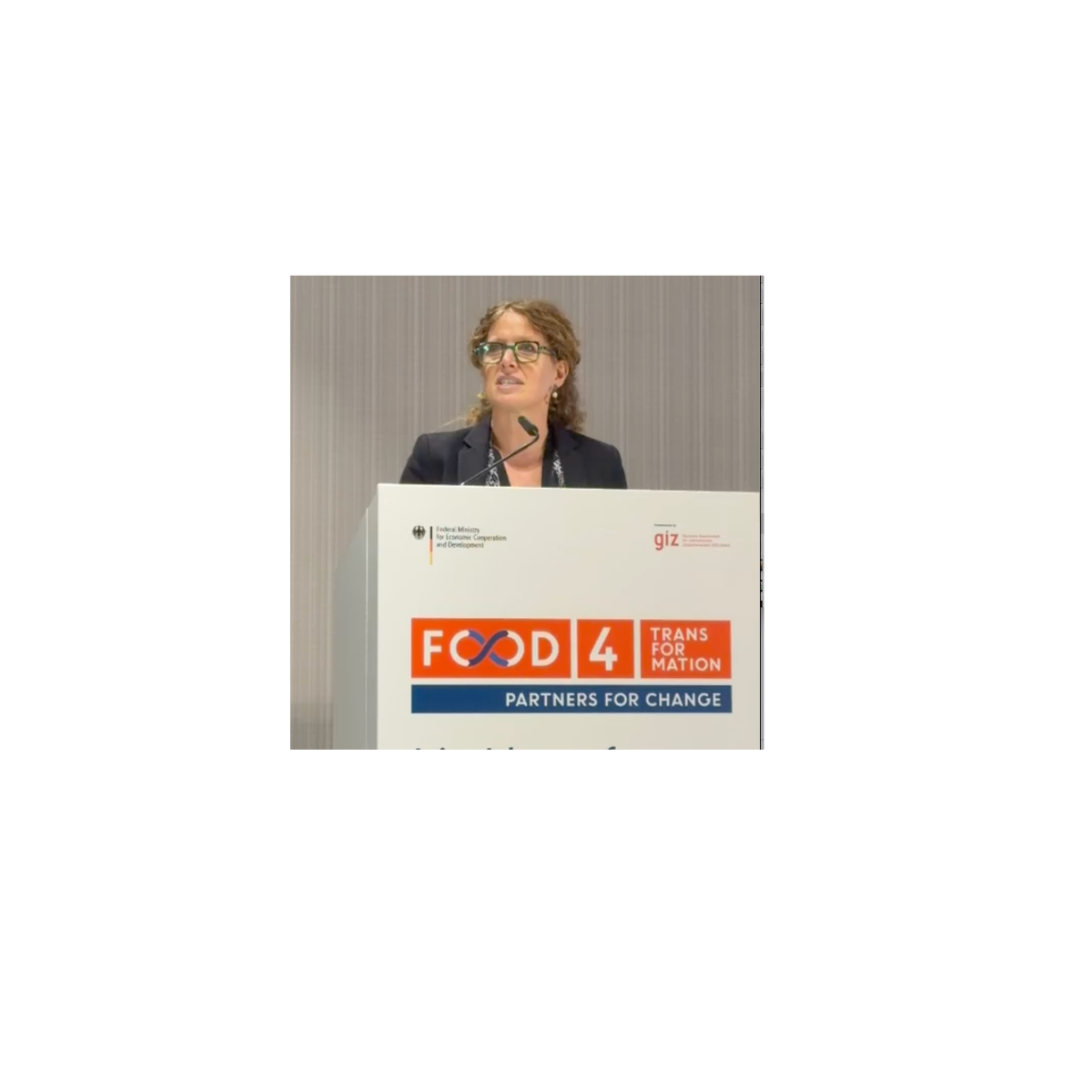
Keynote address at the Partners for Change annual conference 2026
25 June 2026 by Carin Smaller, Executive Director
Can we still solve development challenges like we used to? Of course not, but do we have to throw the baby out with the bathwater? This phrase in English comes from the German “das Kind mit dem Bade ausschütten” which means don’t get rid of the good, when fixing the bad. Can we take the good from the past, learn from our mistakes, and do things differently? Can we build on what works, benefit from future innovations, like the AI, while not being blind to the risks?
This is the spirit of this Partners for Change (P4C).
I was also the spirit of the Hesat2030 project, the successor to Ceres2030. While in Ceres2030 we asked how to end hunger and what would it cost, in Hesat2030 we asked, can we end hunger differently? Can we acknowledge that huge progress has been made, but that the problem is now stagnating, and the way we ended hunger created many unintended consequences: undermining health and nutrition, destroying the environment, and exacerbating inequalities because we allowed wealth to be accumulated into the hands of a few countries and companies that now feed us.
We asked three questions in the Hesat2030 nutrition report: what evidence do we have of interventions in agriculture and food systems in low- and middle-income countries that have focused on healthy diets and nutrition as a way to end hunger? Are there interventions that can also help mitigate and adapt to climate change, increase incomes, and empower women? And, can we bundle interventions together to reduce costs?
These three questions align quite well with the P4C synthesis paper. How do we build functional agriculture and food systems that are present and effective? How do we move beyond productivity and embrace safety and sustainability? And, can we co-create solutions that build hope and are adaptable to rapidly changing circumstances?
In the Hesat2030 nutrition report, we used the evidence from low- and lower-middle-income countries. Artificial intelligence (machine-learning) was used to trawl through 25,000 articles in the database. Humans then brought the critical appraisal. Most of the articles did not pass the human screening for the standard of evidence that we sought i.e. scientifically published umbrella reviews (reviews of reviews). This left us with 52 reviews, based on 1,732 studies across 83 countries in the past 20 years. We then synthesized the findings from these studies.
This resulted in 10 intervention areas where good evidence exists about effectiveness. We grouped them into three buckets to help visualize where in the system they intervene, from production to markets to consumption. However, they can quite easily be mapped to other frameworks, like the one presented by P4C.
In our production bucket, the evidence showed that need to increase the availability and affordability of fruits, vegetables, and pulses, and animal-source foods. But, the evidence also tells us that when households simply receive inputs, such as vegetable seeds, livestock, or fruit trees, without guidance on optimal production, food preparation, or child feeding practices, improvements in income or yields do not always translate into better diets or nutritional outcomes. It is the bundling that makes the interventions effective and leads to the positive outcomes. But we have to be careful of the trade-offs. Home gardens, for example,are effective, and cheap, but they also increase the time and labour burden on women. When livestock is involved, home gardens can increase the risk of disease transmission.
In our markets bucket, the evidence shows that infrastructure is lacking – from cold storage and processing to roads and electricity – to preserve nutritious food for longer, reach consumers with the missing micronutrients and ensure that food is safe. But again, the evidence points to the need to pay attention to trade-offs because infrastructure investments can entrench the exclusion of marginalised groups. And food safety measures can be too costly and therefore unintentionally push SMEs out of formal markets.
Finally, in our consumption bucket, the evidence shows that once we start to produce and market healthy food options, consumers need to be accompanied and understand the change in their food environment. We need to directly shift and influence diet choices through education, communication and labelling.
However, the main challenge is how to finance these investments, especially in the current climate with shrinking aid budgets and where low- and middle-income counties face huge debt burdens. Blended finance can help us solve this problem. While only 2% of ODA in agriculture is directed towards blended finance, it is a rapidly growing space. In our report, we examined several strategies for blending public and private money in the nutrition space, including:
Blended funds that target healthy diet outcomes such as the Nutrition Food Financing Facility (N3F) from Incofin & GAIN.
Social bonds focused on nutrition outcomes in developing countries, such as the World Bank’s USD 250 million Sustainable Development Bond for maternal and child health and nutrition, or Danone’s Bond.
Public procurement using a whole-of-government approach so that food procured by government applies dietary diversity and nutrition standards, including contracts for school meals, as well as catering for public hospitals, government canteens, universities and training institutes, military and police facilities, public events and conferences.
Development Impact Bonds, or outcome-finance, where payment is made for achieving results, rather than delivering activities.
But how do you take big global ideas and put them in practice? This is where the national level is key. Through the Zero Hunger Coalition, one of the coalitions for action that emerged from the United Nations Food Systems Summit, we worked with nine countries to produce evidence-based and costed country roadmaps using the same methodology as used in the Hesat2030 nutrition report.
The difference, however, is that the research focus was guided by a country-led and owned process, established through multi-stakeholder governance structures such as the national taskforces set up in Madagascar, Benin, and the DRC, the Council of Agriculture and Rural Development in Cambodia, and the whole of government approach embedded in the Office of the Vice President in Zambia. In Madagascar, this taskforce has now outlasted three ministers and an election! The evidence was integrated into existing frameworks in the country, including the food systems pathways documents and the national strategies.
Concretely, how did it work? In Zambia, we focused on the government’s target to increase maize production and how it would impact nutrition and the environment. In Cambodia, we focused on the enormous success in eradicating hunger, but the environmental and health problems that are now ballooning.
So where to from here? We need global institutions, processes, evidence, and learning. We have learnt over decades, even centuries, that the world is much better off cooperating and integrating than having each country function as its own island. But frankly, it has been exhausting and confusing to follow the multiple global processes: UNFSS, CFS, SUN, GAFS, GAHP, WFF, etc..
Rather, the global only becomes relevant when it is actioned and implemented at the regional and national level. In Africa, CAADP is the regional framework on which everything else needs to align. Translating globaland regional plans to implementation at the national level is where we can make a lasting impact. It is at the national level where these ideas and plans can become reality. There are great platforms, dialogues, strategiesthat countries have built in recent years. We need to work with them, strengthen them, improve them to deliver the best results. Now it is time to move toward implementation.
To succeed we must focus on the following:
First, we need cooperation at the global, regional and national levels based on shared values around human rights, the rule of law, and accountability. We have not yet acknowledged sufficiently how much these shared values are under threat. It is no longer guaranteed that we have the rule of law, accountability and human rights.
Much more needs to be done by those who believe in these values to safeguard them otherwise they could disappear.
Second, we need to develop our financing strategies. We have done so for advocacy but not for finance. Last year, the World Bank announced it was going to double its spending on agriculture to reach USD 9 billion by 2030 through its programme AgriConnect. That is roughly equivalent to the entire development budget spent by Germany.
But if you look at how the World Bank is planning to spend this money, you will see that it is based on productivity with a focus on staple crops. It is the kind of agricultural development that we've seen decades ago and that needs to be modernised. If we can shape how this USD 9 billion flows, we can make a big difference in the outcomes that we achieve from those investments.
And finally, we need flexibility and adaptability. AI is probably the biggest disruption that I have seen in my life. And it is likely that in a few years, our work environments will not look like they do today. We don't even know what they're going to look like and this change is happening very rapidly. And yes, it is a threat and it needs to be regulated.
But it is also a reality and it is here. Unless we engage with that reality, we are all going to be left behind.